
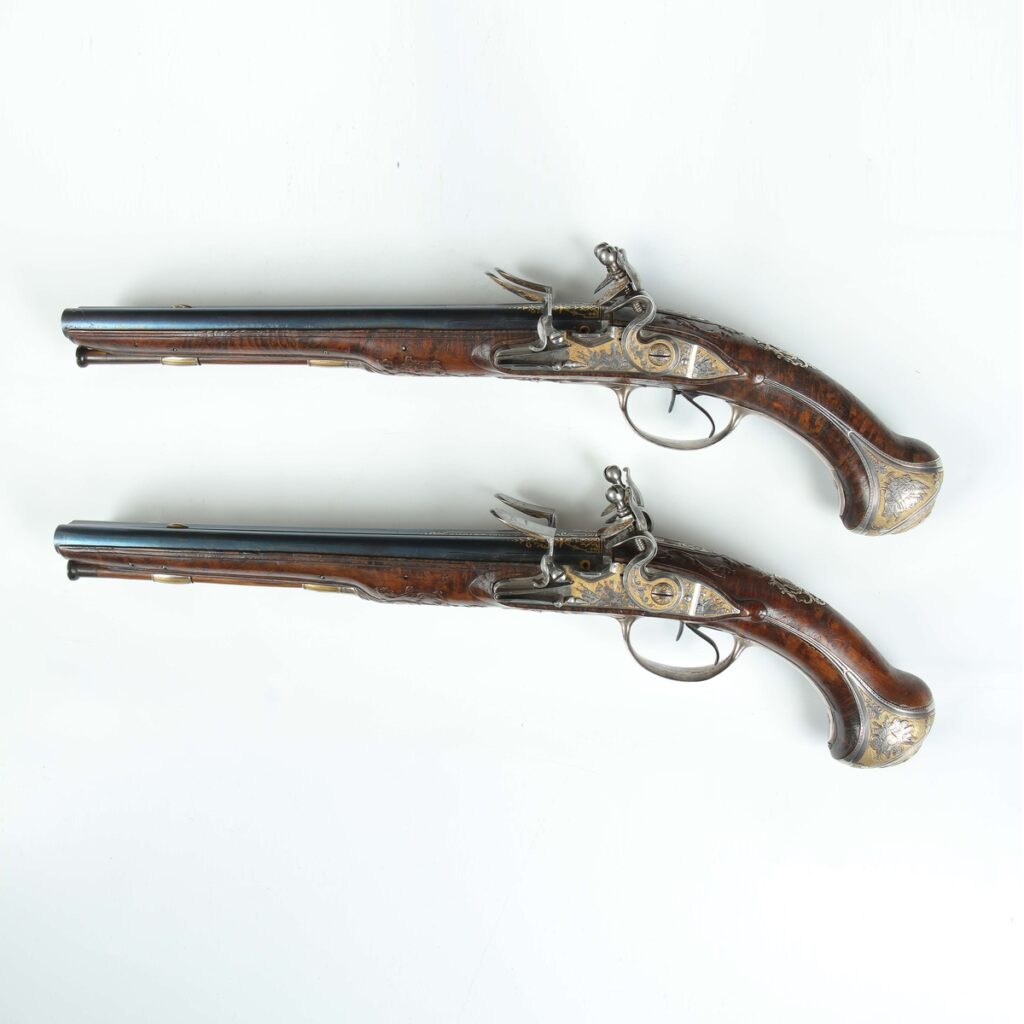
03 Pair of Double-Barreled French Flintlock Pistols, J. Penel, Saint-Étienne, c. 1735. Pistols of Ferdinand Albert II (1680−1735), Prince of Brunswick-Wolfenbüttel (1735).
Fotogalerie
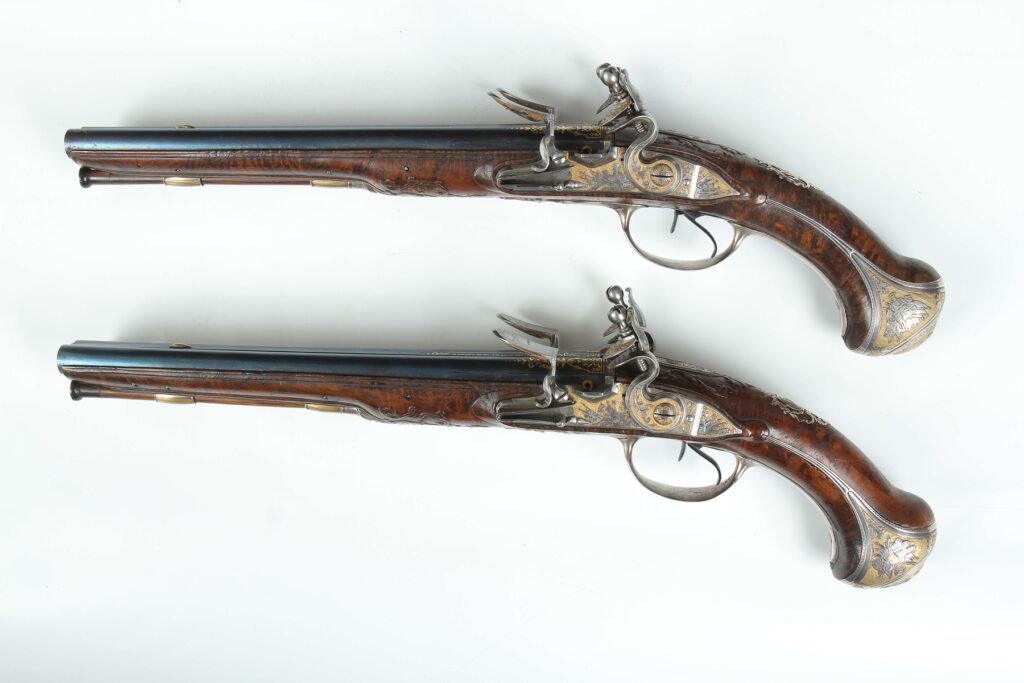
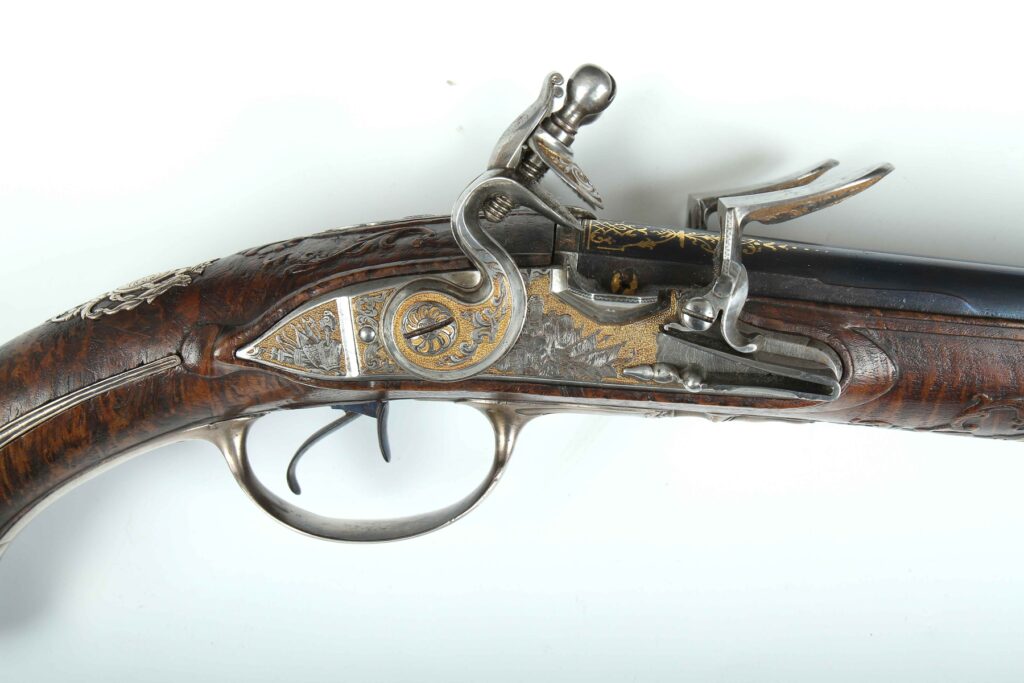
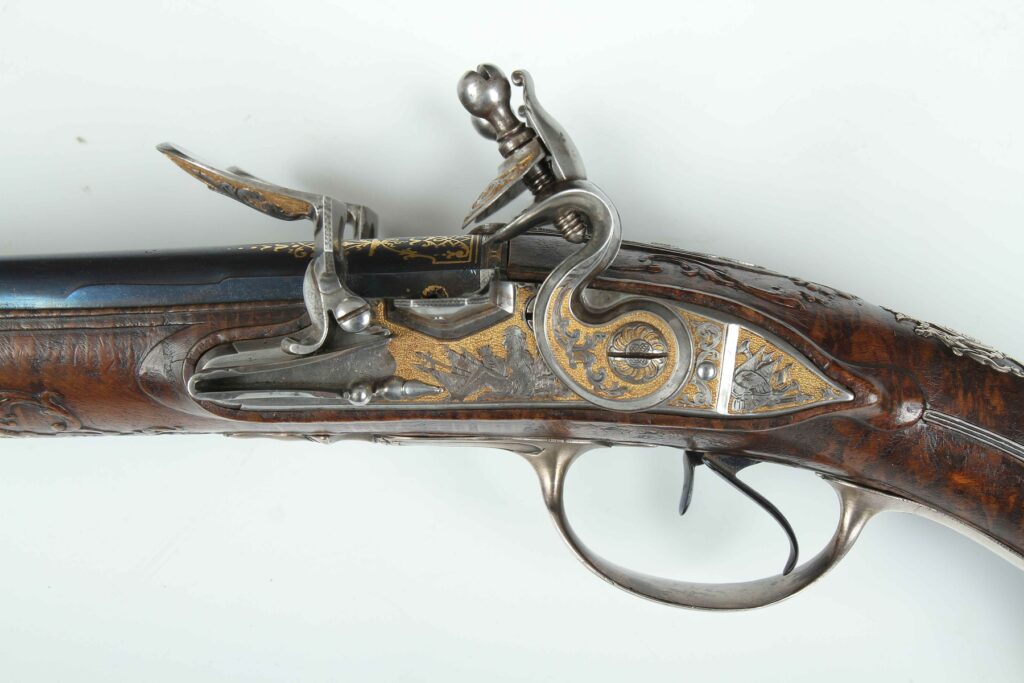
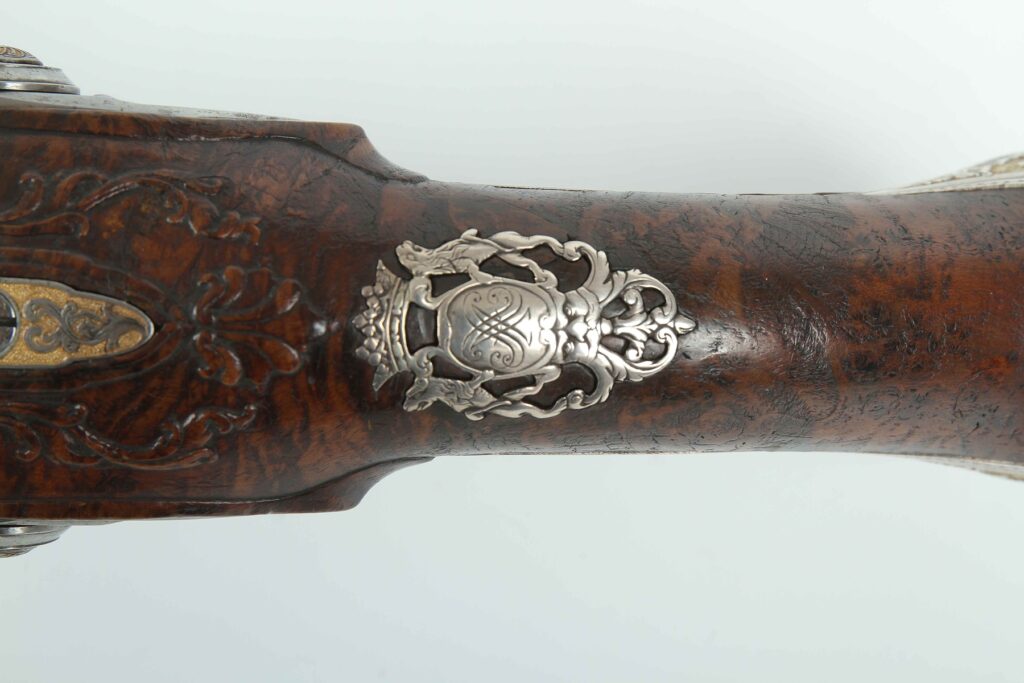
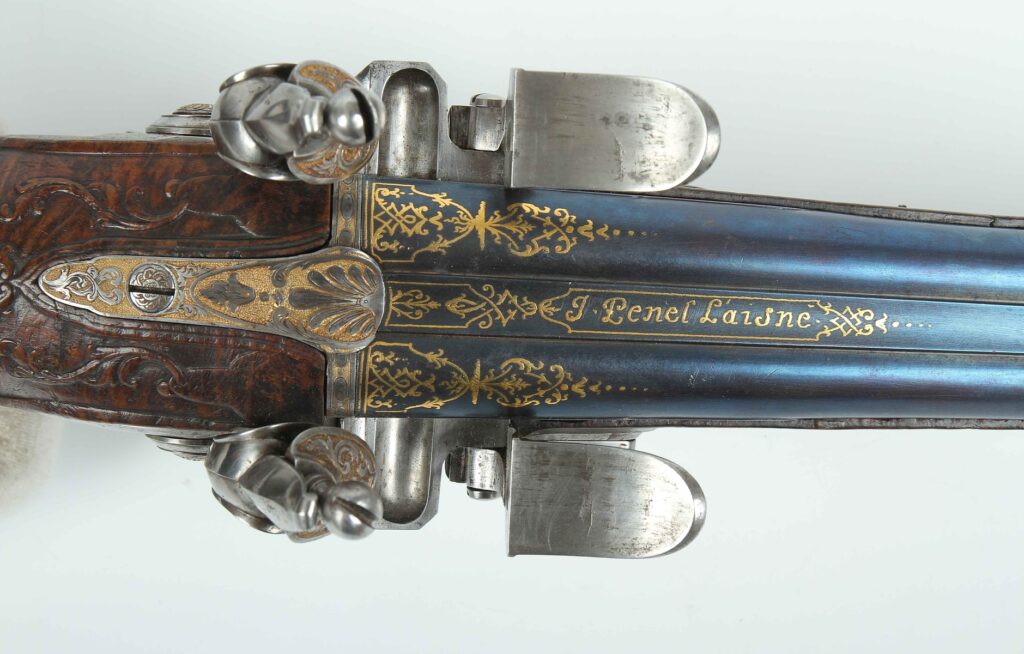
The displayed double-barrelled pistols are an example of gunsmithing of above-average quality, ornate and flamboyant, and were made for an important and wealthy customer. They represented their owner, his lifestyle and his position in society.
The barrels of both pistols are decorated with an impressive combination of a blued surface with the technique of damascening and the signature gold wire that protrudes above the surface. The decoration used on the rail between the barrels includes a frame with the signature of the pistol maker, “J. Penel L’aisne”.
Stöckel’s list of the world’s gunsmiths includes several names of this rifle family under the name of J. Penel, active in the French town of Saint Étienne. Of these, Jacques Penel (1729–after 1800), who signed his work Laisné (Sr.), as it appears on our pistols, is the most prominent. However, as will be explained later, we know with a level of probability bordering on certainty that the pistols were made between 1731 and 1735. Therefore, it is clear from the year of his birth that this gunsmith could not have been their maker as he was only 2 to 6 years old at the time. Probably the only correct maker’s name is Jacques Penel, born in 1670, who was 61 to 65 years old at the time the pistols were made, which, based on fact that he had a son of the same name, would be consistent with his legitimate claim to use the appellation Laisné.
The stocks of both pistols are made of very high quality rootwood and have a distinctive and uniform texture. Their colour is brown and the surface varnish is satin glossy. A back plate with a composition of two lions with their paws resting on an oval shield with the owner’s monogram “FA” is embedded in the necks of the arms. The monogram is stylised and, as was customary at the time, mirror-paired along the axis. The upper part of the plate bears a crown, the lower part a mascaron and tendrils. Howard L. Blackmore’s 1968 publication Royal Sporting Guns at Winsor was instrumental in finding the owner of the guns. Figure 30 there shows the gun’s thumb plate and the monogram on it are identical to that on the guns described. The author tentatively concludes that the initials on the plate are the letters IA, but this is not a correct interpretation. The text further indicates that the described gun was made by Johan Ulrich Mänz, who was court gunsmith to Louis Rudolph, Duke of Brunswick (1671–1735). From his biography, we can trace the real owner and the true meaning of the monogram on the gun’s thumb plate. Duke Ludwig Rudolf had four daughters. The eldest, Elisabeth Christine (1691–1750), married the Spanish King Charles III, later Emperor Charles VI of Rome, and became the mother of the future Empress Maria Theresa. The youngest of the daughters, Antonia Amalia (1696–1762), married Ferdinand Albert II, Duke of Brunswick-Wolfenbüttel (1680–1735) on 15 October 1712, and since Duke Rudolf had no male descendants and Ferdinand Albert was also his first cousin, he became the heir and successor in Brunswick-Wolfenbüttel. The weapon described in the book was actually made at the court of Louis Rudolph by his court gunsmith, but most likely it was a gift to Ferdinand Albert II. The pistols purchased for the collection of the Military History Institute could have been used in the same way, i.e. as a gift. However, it is undisputed that their owner, whose monogram FA is engraved on the thumb plate, is identical.
Length 450 mm, barrel length 276 mm, calibre 13.95 mm, weight 1,204 g.
Aktuálně

Bitva u Chlumce – triumf knížete Soběslava před 900 lety – 18. 2. 1126
Úpravy plánu zbrojní výroby v letech 1958 až 1960
Veteráni UNPROFOR/ UNCRO opět vzpomínali na svou misi
Připomínka data narození: JOSEF BUBLÍK / 12. února 1920 - 18. června 1942
Jak Veteráni budoucích válek otřásli Amerikou





Vojenský historický ústav Praha
U Památníku 2, 130 05, Praha 3
muzeum@vhu.cz
Ředitelství
Ředitel VHÚ Praha
brigádní generál Mgr. Aleš Knížek
Sekretariát ředitele
+420 973 204 900
ID DS
hjyaavk
Správní rada pro vyřízení vývozních povolení, darů či výkupů
+420 973 204 903
Správní rada pro vyřízení zápůjček
+420 973 204 900
Veškeré informace týkající se zápůjček exponátů na výstavy a další akce, formuláře pro vývoz milirarií, práva k fotografiím a filmovým sbírkám atd. naleznete v samostatné rubrice Služby veřejnosti.
Knihovna VHÚ
Pracoviště Rooseveltova
+420 973 215 544
Vedoucí knihovny VHÚ
+420 973 215 938
knihovna@vhu.cz
Časopis Historie a vojenství
Šéfredaktor
David Pazdera
+420 973 204 941
Armádní muzeum Žižkov
U Památníku 2
Praha 3 - Žižkov
+420 973 204 924
Letecké muzeum Kbely
Mladoboleslavská ul.
Praha 9 - Kbely
+420 973 207 500
Vojenské Technické Muzeum Lešany u Týnce nad Sázavou
Lešany u Týnce nad Sázavou
pošta Krhanice, 257 42
+420 973 296 161

