
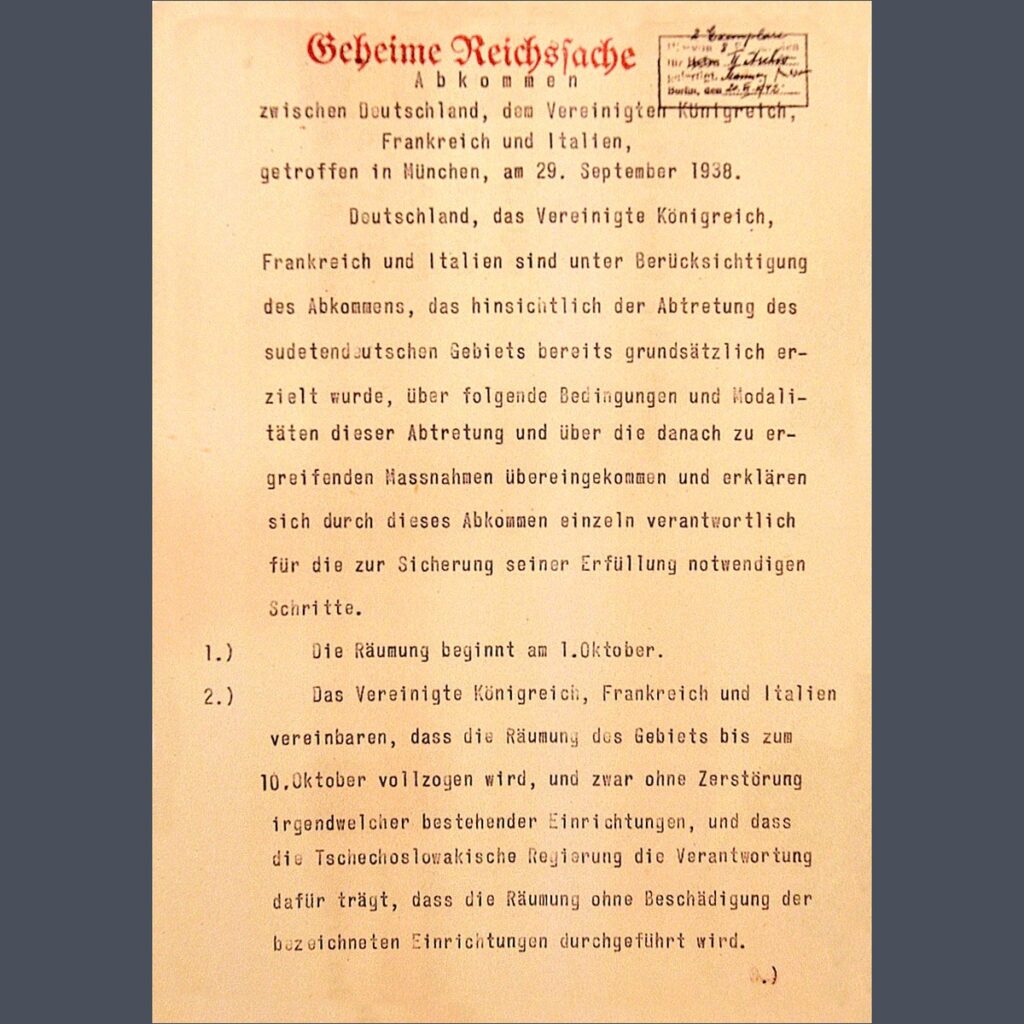
01 Munich Agreement
Fotogalerie
In 1938, the Czechoslovak Republic found itself at a fateful crossroads. The first concept of German military troops attacking Czechoslovakia was produced as early as mid-1935.
The steps that the Sudeten German Party – which became, under the leadership of Konrad Henlein, the strongest political party in Czechoslovakia after the 1935 parliamentary elections – took from spring 1938 followed Hitler’s directives requiring the party to raise impossible-to-meet requirements towards the Czechoslovak Government. After the March Annexation of Austria (Anschluss) and the surveillance of the border in May, September 1938 arrived. The tense international situation and Germany’s escalating requirements resulted in the declaration of the mobilisation of the Czechoslovak Army. Shortly after came one of the major turning moments of the country’s history. On 29 September 1938, shortly after midday, the leaders of Germany, Italy, Britain, and France met in Munich. No participation of the Czechoslovak Government leaders was foreseen. The wording of the Munich Agreement was signed on 30 September 1938, shortly after midnight. Based on the pact, the Czechoslovak Army, which was determined to fight and well-organised, was forced to give up and render the borderland area of the State to the enemy without a fight. The removal of the Czechoslovak State as the last democracy in Central Europe was the direct consequence. In addition, Germany, Poland and Hungary were assigned a total of 29.6% of the original territory of the state, i.e. 41,596 square kilometres. The population loss amounted to 4,879,000 – as much as one third of the original number.
Aktuálně
Připomínáme si 78 let od neobjasněného úmrtí Jana Masaryka
Výstava „1945-Voláme všechny Čechy!“ prodloužena do 8. května 2026

V neděli 8. března se v Sokolovu uskutečnil pietní akt

Připomínáme si výročí bitvy u Sokolova - 8. 3. 1943
Připomínáme si 176 let od narození prezidenta T. G. Masaryka




Vojenský historický ústav Praha
U Památníku 2, 130 05, Praha 3
muzeum@vhu.cz
Ředitelství
Ředitel VHÚ Praha
brigádní generál Mgr. Aleš Knížek
Sekretariát ředitele
+420 973 204 900
ID DS
hjyaavk
Správní rada pro vyřízení vývozních povolení, darů či výkupů
+420 973 204 903
Správní rada pro vyřízení zápůjček
+420 973 204 900
Veškeré informace týkající se zápůjček exponátů na výstavy a další akce, formuláře pro vývoz milirarií, práva k fotografiím a filmovým sbírkám atd. naleznete v samostatné rubrice Služby veřejnosti.
Knihovna VHÚ
Pracoviště Rooseveltova
+420 973 215 544
Vedoucí knihovny VHÚ
+420 973 215 938
knihovna@vhu.cz
Časopis Historie a vojenství
Šéfredaktor
David Pazdera
+420 973 204 941
Armádní muzeum Žižkov
U Památníku 2
Praha 3 - Žižkov
+420 973 204 924
Letecké muzeum Kbely
Mladoboleslavská ul.
Praha 9 - Kbely
+420 973 207 500
Vojenské Technické Muzeum Lešany u Týnce nad Sázavou
Lešany u Týnce nad Sázavou
pošta Krhanice, 257 42
+420 973 296 161

